 Link
Link
11/20/2025

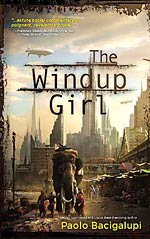
A future Thailand whose infrastructure and economy are devastated by the errors of genetic engineering, leading to a badly damaged foodcrop. There are 4 POVs, and Bacigalupi is expert at making them come alive amidst a very complicated worldbuild. I was able to identify and care about all of them equally, which is truly a bonus because even if only one is entertaining, the book is still a tour-de-force.
Anderson is a farang (foreign) entrepreneur trying to create more opportunities for import into a country that is overly insulated and restrictive of interaction with the outside world (for good reasons as mentioned above) and he comes across a unique ngaw fruit that is mysteriously resistant to the various plagues and diseases that have all but eliminated the pre-Contraction fruit crops ('contraction' here referring to how the world's countries became ever more isolated with the interruption of fossil-fuel driven transportation).
Hock Seng is a Chinese immigrant working for Anderson, who used to be in control of a successful shipping industry pre-Contraction. He oversees both the illicit algae factory (for gene research) and the "official" spring factory (wherein kinetic energy is stored in sophisticated wound up springs, which act as the primary replacement fuel source in lieu of fossil fuels). Hock Seng is ever on the lookout to improve his tenuous status and reclaim what he once had.
Jaidee is an overzealous official for the Environmental Ministry (a "white shirt"), which seeks to strictly regulate Thailand's imports after the disasters that nearly destroyed the country and essentially laid waste to its SE Asian neighbors of Burma, Vietnam, and India. He has a habit of accepting bribes (which are rampant), but confiscating and/or destroying shipments regardless, earning the nickname of the Tiger of Bangkok. This leads to retribution against him of a personal nature (the kidnapping of his wife and subseqent demotion after being forced to turn himself in). We see his efforts to repair his life. Spoiler: His successor, Kandra, has an engaging struggle as she tries to reconcile loyalties between both the Environmental and Trade ministries, who are at war with each other over the ultimate fate of Thailand. She is a double agent and she must balance her own personal moralities vs. her "double agency". Arguably the most complicated character in the book, but the author only really begins to follow her story halfway through.
And finally, there is the titular character of Emiko, part of the New Person population created by Japan. Her artificial windup nature contributes to hers being the most emotional and heartfelt of the POVs (but even without this, it would still be so). Her Japanese patron abandoned her in Thailand, leaving her to a life of sexual slavery that she is desperately trying to escape in favor of the rumored windup colony up north that exists independent of human authority. All the POVs are connected in some way, but her relationship with Anderson is obviously the most apparent and dramatic.
The reader is completely immersed in Thailand's dystopian future -- it is flawlessly rendered. A very strong Hugo winner; absolutely no question of its quality.