 BigEnk
11/22/2025

Not since reading Hyperion have I felt this divided about a work of SF. There's no way that I would be able to cover the plot of A Fire Upon the Deep in an appropriate amount of time, but I'll cover the basics for posterity's sake.
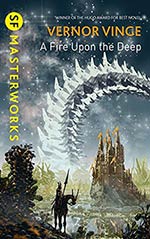
The Milky Way is split up into concentric rings radiating out from the galactic center that define the upper limit of thought and technology. At the core, in the Unthinking Depths, there is no rational thinking, no civilization, no sophonts of any kind. On the outskirts of the galaxy, in the Transcend, intelligent species become what essentially amount to gods. It is here, at the edge of the Transcend, that a group of human researchers discover an ancient, forgotten data archive. It is here that they unknowingly awaken something called the Blight, a virus in the data that is capable of spreading and assimilating all life into a corrupted hive mind. Some of these researchers escape with a potential antidote to the Blight, and flee to the lower levels of the galaxy in an effort to escape it. Their shuttle crashes on a world of medieval technology inhabited by the Tines, a species of intelligent weasels/dogs that function as a collective intelligence; 4-8 individual members that are otherwise only semi-conscious combining to create one whole individual. The plot centers around these humans as they struggle to survive and understand the Tines, and another group's desperate attempt to find and recover the antidote; to prevent the destruction of the galaxy.
Like I said, it's a lot. That's just the bare bones of it. And what sweet, delicious, dopamine filled bones they are. A significant portion of Vinge's ideas give me the adrenaline rush of creativity and newness that I think is stereotypically associated with SF. I love the Zones of Thought. I love the Tines, their collective intelligence, the philosophical questions about the soul that they raise. I love the skroderiders and their adaptation to long-term versus short-time memory. I love that the galaxy feels vast and unknowable in the quantity of intelligent species. I love the implied billions of years in history that sits under these transient cultures. The richness and sheer quantity of ideas in A Fire Upon the Deep make it super memorable.
Surprisingly enough, I even enjoyed the ending, which is not something I can say about many of these sweeping space operas (or to be frank SF in general). The motif of oceans, waves, the inter-tidal space was quite striking. It is often in the messy and violent spaces between two disparate things, where they meet and cohabitate, that some of the most unique creatures and ideas can come from. As this is true of the ocean and the shore, such is true of the contact points between layers of the galaxy. Much like the ocean, the galaxy also follows a cyclical pattern of events, like the tides or the discrete repetition of an individual wave on the shore, that have massive effects on the species that call that place home. Even though the effects may indeed be world ending on a small scale, the system as whole continues to function, and will provide refuge for new individuals, species, and ideas in the future. I enjoyed how Vinge tied the Skroderiders and Tines into this broader analogy.
Where Vinge fails miserably is in the details: in the moment by moment execution of these ideas and the plot that holds it together. Battle sequences are often muddled, confusing, and poorly drawn. The plot follows several side tangents for far too long, which is ultimately one of the factors leading to its undeniable bloat. The actions of the Blight always happen the background; we barely get to see one of the coolest things in the whole book. Most of the characters are tossed off and shallow in their portrayal. The main Tinish villain is not just intellectually stupid, but cartoonishy so. The love interest between Pham and Ravna was completely unnecessary. Too often Vinge's writing is amateurish and beneath his true capabilities, because infrequently he throws in a line or two that actually have some artistry to them.
None of these flaws are a death sentence on their own, but totaled together they make for a nasty quagmire of quicksand that Vinge frequently dives headfirst into. There's also the dated idea of the Net, that all intelligent species communicate on. Perhaps in 1992 this was forward looking, but today it's a hunk of limestone amongst glittering diamonds. Are we really meant to believable that the best communication that the galaxy can muster is a 4chan forum?
Unfortunately, what I am left feeling is that; had these concepts and ideas been given to a better writer, this could've easily been one of the best books I've ever read. Vinge's capabilities as a writer acted as an anchor dragging everything down. I also fear that much of my enjoyment derived from the novelty and unknown of the zones of thought. Were I to re-read this novel, I wouldn't have the newness to balance out the drudgery. More than most books, A Fire Upon the Deep benefits from a blind reading. Even though the first hundred pages were by far my favorite, I still understand why it has the massive reputation it does.