 BigEnk
12/18/2025

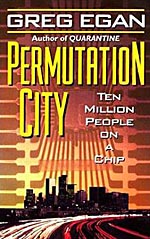
A personal high water mark for hard SF. In Permutation City, the rich can afford to download their consciousness into a version of virtual reality. Having attained this form of immortality, they can edit their own soul to match their preferences for life. Copies run at a much slower tick rate than our reality, in part due to the limits of computing, which means that to properly communicate with a copy, people must essentially go into a coma so their brain speed matches with their copy. Unsurprisingly, there's a messy relationship between AI copies and their 'real world' counterparts that Egan explores both technological and philosophically. How much can we change ourselves before we become someone else entirely? What truly exists or counts as conscious life? Is anything real except the mind (Solipsism)?
Parallel to these advances, there's a version of reality called the Autoverse, where life is simulated as one-to-one as possible. One of the main characters, Maria, discovers that biota in the Autoverse can evolve similarly to the real world, which means that a whole separate universe could exist separately from our reality with the processes of a computer, though the computing power to run this universe would be beyond current computing limits. Despite that, Maria is contracted to build a theoretical model for this Autoverse universe by a man named Paul Durham, who is creating a private 'Garden of Eden' settlement in VR for the copies of his of corporate elite clients that will allegedly be immune to commodity market that processing power exists on. I know for a fact that I'm horribly butchering this summary, but that's partially due to just how ambitious Egan is in Permutation City. This work really has to be read to have a grasp on all that it tries to do.
I connected to this work intensely, even though a lot of the 'dust theory' went over my head. It's dense, ideas heavy, but with super digestible prose that reminds me of Egan's contemporary, Robert Charles Wilson, if he spent less time on characters and more time on quantum mechanics. Perhaps that's (at least partially) why I enjoyed it. I enjoy feeling challenged, like I'm only scratching the surface of what there is discover about a work. I will admit, though, that I debated whether the difficulty that I had with some of Egan's concepts derived from their inherent complexity, or if he simply poorly communicates them. I can see both sides of this argument, and wouldn't begrudge someone at all for disagreeing with me. Even though it's not a long novel, it feels as though it is; Egan's density takes time to contend with.
As much as this is a novel of ideas over characters, there's also some very gripping plot points that kept me engaged with the story too. There's a scene in a shower that's very reminiscent to a similar scene in Greg Bear's Blood Music, and shocked me nearly as much. I always appreciate when the scope of a novel continues to grow until its humble beginnings are barely recognizable to the concluding drama.
Coincidentally, I heard a news story just before reading Permutation City about the CEO of Zoom talking about how he's looking forward to the imminent use of AI to attend meetings in your stead while using a mask of your face and copy of your personality/knowledge base. This is of course a hyper specific example, and I don't personally put much stock into prescience when it comes to SF, but I couldn't help but shiver at Egan's perceptiveness when it came to most facets of AI.