 hillsandbooks96
8/7/2026

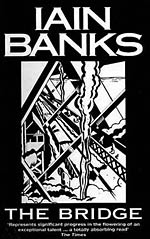
So it turns out that I not only started with what is often cited as Iain Banks's most difficult SF novel (Feersum Endjinn), I made my second read what is perhaps his most difficult novel full stop. Iain Banks's imagination once again impresses. This is a complex, labyrinthine novel that I do think is better than Feersum Endjinn; more ambitious, which seems strange given that The Bridge occurs entirely in the mind of one man. This man is introduced to us as 'John Orr', who wakes up in a huge megastructure taking the form of a great iron bridge redolent of the Forth Bridge. He has no memory of how he got there or what happened to him, only aware that he was fished from the water and is a patient of a Dr. Joyce, to whom Orr explains his dreams in a hope of piecing together what happened to him.
Orr meets the alluring Abberlaine Arrol, daughter of one of the bridge's engineers, and this 'main' plot is interwoven with chapters following a barbarian who speaks in Scots dialect and whose chapters are written phonetically (drawing instant comparison with Bascule the Teller's chapters in Feersum Endjinn), and another that recalls Orr's life up until the accident, in which we learn of his real life. It is through this that we learn of the significance bridges play in the protagonist's life as we learn of his education, early adulthood and personal life.
One thing in particular that I thought Banks did exceptionally was blurring the boundaries of where Orr's dreams end and where his reality begins, as it gradually becomes more apparent that they are bleeding into each other. The events occurring in the other two 'sub-plots' having a 'real-world' impact on Orr's story is alluded to by way of one of the Barbarian's PoV chapters, in which a fire is referenced, connecting to when Orr attempts to go to the Third City Library (where he hopes to find out about the Bridge's secrets, such as whether it connects to any land) and finds that a fire has gutted the library. These connections between the main character's life and what is manifesting in the world of the Bridge become more and more apparent as the novel finally starts coming together, but it does take quite a while for it to truly do so (perhaps around the final quarter) and this may test the patience of many readers.
Within literature, The Bridge reminds me most of works by Italo Calvino: (If on a Winter's Night a Traveller for its 'stories within a story' device, and Invisible Cities for its architectural structure and theme), as well as Paul Auster's City of Glass. Banks himself cited the fellow Scot, Alasdair Gray's Lanark, as an influence; however, I have not yet read that work.
Outside of literature, however, and perhaps what The Bridge smacks of most to me, is Terry Gilliam's film Brazil, as well as a little of Fritz Lang's 1927 film Metropolis for some of the aesthetic of the novel's primary setting. The architecture of the Bridge: its layers, girders, elevators, brass surfaces, the Bridge feeling like a world all unto itself -- even its little rickshaw-like taxis - contributes to this, but also the frustrating bureaucracy that Orr has to contend with. For a substantial portion of the novel, Orr is trying to locate the 'Third City Library' which he is continually unable to find or thwarted from entering. Another scene has his telephone malfunction, only for the door of his apartment to then fail to open, and the engineers leaving to attend to another job and the telephone remaining broken. While the revelation of the book informs us that this was not strictly the result of bureaucracy as such, the kind of half-horrifying, half-humorous feeling it instils is certainly similar to Gilliam's Brazil.
There is not much more I can go into without spoiling too much of the novel's conceit, but all in all this was one of those novels that kept me thinking about it whilst I wasn't reading it, trying to work it out, eager to pick it back up again. It may have just pipped The Crying of Lot 49 to take 1st place on my favourite reads from David Pringle's Modern Fantasy list, and certainly the best of the ones I've read so far this year.
https://www.goodreads.com/user/show/158820077-dan-roebuck