 bazhsw
10/11/2026

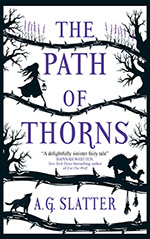
It’s autumn, I’m reading the ‘Path of Thorns’ and the overwhelming feeling I have is that I want to wrap myself up in heavy blankets, all cosy and nice and sink into whatever else A.G. Slatter has to offer in her Sourdough setting. This book is wonderfully evocative and as a reader I immediately immersed myself into a world of old creaking houses, governesses and guarded staff. Of remoteness, a village and its residents dependent on the whims of ‘the big house’. Of sexuality boiling underneath, of scandal.
‘The Path of Thorns’ can best be described as a gothic horror ghost story fairytale that leans into familiar tropes of urban fantasy and mystery thriller which addresses themes of gender, sexuality, dysfunctional family relationships and abuse. Wrapped up in witchcraft. So you can tell, it draws its influences from different genres yet it feels like a consistent setting and story without feeling like a ‘mash-up’.
The basic premise of the story is that of a governess called Asher Todd. Asher is to be the new governess of the Morwood’s with rather archetypal stern father and demure but mentally strained mother and three children. We learn early that the estate of the Morwood’s is at times wild, but also quite a threatening place with fear just out of sight, but felt nonetheless. We also learn that Asher is not quite who she seems, that she is here for ulterior purposes, and knows something of what has happened in the home in the past. We also learn that she has magical inclinations, and that the presence of such magic puts her at risk in a religious society that will torture and kill witches if so inclined
I won’t get into spoilers here but please be mindful if reading on, that some of the themes discussed and what I like, or don’t like about the book may tell the reader more than they care to know. I’ll also mention some trigger warnings in the book shortly for readers (so again, back out if you don’t wish to know). I had read some criticism that this book looked like a ‘young adult’ book and it was inappropriate. I’m of the view that the imagery and content would appeal to a young adult readership. I’m also of the view that whilst it deals with adult themes and can be challenging at times, it’s not something which I would especially baulk at a teenager reading. There’s a little bit of ‘fade to black’ sex, but there are themes of domestic abuse, sexual violence, child abuse (emotional and physical), abortion and relatively graphic ritualistic animal death. That said, the ‘real world’ themes in the book are something which are important and will resonate with readers of different ages.
So, what does this book do well? It leans into gothic archetypes without ever feeling derivative. There’s the old creepy house, antagonistic staff, locked rooms, secrets under floors, a matriarch hidden upstairs, there’s a sense of remoteness to the village that help is not to close. We’ve surly innkeepers and cold, unwelcoming churches.
From a character point of view, I quite liked Asher Todd as a morally grey character. You want to root for her early as the ‘governess with a mission’ in an unwelcoming household. As the story develops and she tries to influence her world and events, we have an early mindset of viewing her as someone to like, a heroine. That does change. She does some pretty horrible things, some selfish things. They can be viewed in the context of either achieving her goal, or responding to circumstances around her. She gets deeper and deeper into some quite abominable ideas and events and in part because she has trapped herself there and in other parts because she has chosen them. I think there is a balance here that works quite well. It isn’t that she is ‘a bit good and a bit bad’ or that she is some kind of anti-hero. Rather it is that her overwhelming mindset is to achieve a goal, that goal is a result of interpersonal dynamics and trauma, but also that she too has her own darknesses, and they are not just because of external factors. By the end of the novel, I didn’t like Asher Todd, and neither do I expect we are meant to.
From a plot point of view, I quite liked the interweaving of fairy tales and story telling in the novel. There’s a really interesting interpretation of ‘Red Riding Hood’ in there, and stories are used to explain the past or current. The novel’s title is used as a story which brings the book together.
I also appreciated a few of the sub-plots in the book. Although there is a central theme, the mystery of the book is introduced well by a separate sub-plot and in the early parts of the book it isn’t clear why things matter, what Asher’s purposes are or how things interlink. It’s pretty effective in leaving space for the reader to want to read more and learn what is going to happen.
Pacing is interesting, because after our broody, gothic start, wider plot points, and actions in the book ramp up the tension. Often, I notice this about two thirds into a book, when we are heading to a conclusion and you’re thinking, ‘how on earth is this going to resolve?’ when there are so many moving parts and it seems like there is no way out for the central character. I noticed this about a third in! It becomes a novel where I was compelled to keep going, where I was excited and keen to see where it would go. The novel ramps up in both the levels of bizarre and levels of horror. I don’t scare so easily but there are parts where this gets a little unsettling. Sadly, I am not sure if the pay-off matches the build. I felt a little deflated and disappointed by the end. It’s a common problem with books with thriller or action elements, in the sense that they can struggle to have a crescendo fitting with the rest of the book. I reminded myself that for most of the book I was enjoying myself and having a generally good time reading and that a flat end didn’t detract too much.
Thematically, there is level of bravery in the book in how it challenges the role of women. As wives, as objects of desire, and how their knowledge is treated as witchcraft in a patriarchal religious society. On a surface level, it addresses women’s bodily autonomy and birth control, there is some representation of lesbian characters (mostly incidental). I do think the book needed to tread a little carefully in respect of how gender identity was approached, and truthfully, I’m not sure it treaded carefully enough. But despite an overlaying of ‘lord of the manor sleeps with every woman in the village’ and the themes of domestic violence, really this book is about women who hate women. It isn’t a book about a sisterhood of witches against the patriarchy. It’s a book where women’s jealousies, insecurities, choices to dominate, choices to abuse take centre stage. One can take a view that this can be read as an inter-generational cycle of abuse where abused becomes abuser but I think it is far more nuanced than that, far more complex. Morally appalling actions exist outside of the relationships between characters, and are probably more contextual. My understanding of why things were happening and awareness that things were not linear, or causal made for a richer enjoyment of the book.
I’ve mentioned the ending as something I didn’t particularly like. I’m not quite sure the theme of lycanthropy adds much to the book in terms of anything other than colour and analogy. The romance sub-plot is a little bit underwhelming. I’m still not sure why they’d hit it off in the first place, or why they keep going back. Or maybe I just didn’t care. The mother of the house Jessamine disappears mid-book, and I get it, the story isn’t really about her and I suppose it adds to the notion of the ‘invisibility of the woman’ element of the setting. I did find her of potential interest though and it seems she’s written out because if she’s around the rest of the novel can’t happen. Maybe she’s out of the way to show she’s the decent one? I’d love to know her views and influence over the end of the novel though.
Overall, I’m giving this a strong recommendation. I loved the setting and atmosphere throughout. I wanted more. I appreciated the complexity of the characters and their intentions. It’s not a perfect book, but it’s a book I loved spending time with.