 BigEnk
4/20/2026

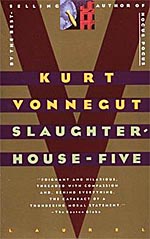
Slaughterhouse-Five presents Vonnegut in a more serious mode than most of his other work. Sure, there's still a prevalence of his darkly ironic and silly humor, but it plays second fiddle to grappling with the bombing of Dresden, something he lived through during WWII. As such, Slaughterhouse-Five is partially autobiographical, along with perfectly balancing the line between genre and literary fiction.
Billy Pilgrim isn't especially good at anything, at least as it pertains to the traits that the U.S. Army values. A shame, since he gets drafted late during WWII to serve as a member of the clergy. Carrying no gun and with seemingly no ill-will towards anybody, he is immediately captured by the Germans and taken in as POW. It is within these war experiences that Billy begins to travel in time, surveying the events of his life from beginning to end out of sequence with one another. Despite its grim content, the novel itself reads really light and breezy like most of Vonnegut's works, and though it plays out non-chronologically, in my opinion it's one of his more coherent works as well.
This time travel element is such a neat way of presenting and discussing PTSD. Nearly all of the sequences of time travel are nucleated by Billy seeing/doing/hearing something that directly correlates with something that happened during the war. Billy is a deeply troubled person who struggles to come to terms with everything he witnessed. During the war, he travels in time to escape the horrors of his current reality, and afterwards he does so as a way of processing his feelings. Billy more-or-less comes to some sense of resigned acceptance about the circumstances of his life, somewhat similar to George Orr's expression of Daoism in Le Guin's The Lathe of Heaven. He does so by imagining all of the events of his life playing out simultaneously, forever. He's able to cope with the many tragedies and deaths he has experienced by imagining that the positive moments and the lives of loved ones are still actively taking place, no matter where he currently finds himself. The alien species that Billy is eventually kidnapped by, the Tralfamadorians, have a certain brand of this fatalism that views all events as predetermined and unchangeable, and idea that echos from his much earlier work The Sirens of Titan.
As I've worked my way through Vonnegut's works as an adult, I've come to appreciate the connections between his novels. Though it's a stretch to imagine that there's a cohesive universe between his works, the same characters, locations, and ideas crop up again and again in a pleasing way.
This is one of those 'classics' where I feel like there's nothing I could possibly add to the discussion on. It's taught in schools for a reason; it's an inspiring work that makes you want to write, and it presents plenty of layers for rich discussions. Vonnegut remains one of the only writers whose humor I really appreciate and connect with. I think I've said this before about him in other reviews, but regardless of whether Vonnegut's distinct flavor agrees with you, I think it's hard to deny that his creativity and writing flair make Vonnegut unique amongst his peers. I highly recommend Slaughterhouse-Five, whether you're reading it for the first time or returning to it again after primary education.