










 Full Details


Added By: Engelbrecht
Last Updated: Engelbrecht
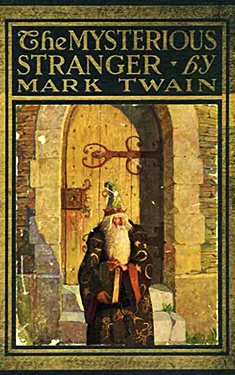
The Mysterious Stranger: A Romance


| Author: | Mark Twain |
| Publisher: |
Harper & Brothers, 1916 |
| Series: | |
|
This book does not appear to be part of a series. If this is incorrect, and you know the name of the series to which it belongs, please let us know. |
|
| Book Type: | Novella |
| Genre: | Fantasy |
| Sub-Genre Tags: | |
| Awards: | |
| Lists: | |
| Links: |
|
| Avg Member Rating: |
|
|
|
|


Synopsis
The Mysterious Stranger is a novella by the American author Mark Twain. Rather than a single finished work, it exists in several distinct and unfinished versions, all written between 1897 and 1908. Each version features a supernatural character--named either Satan or No. 44--who exposes the moral contradictions, cruelty, and illusory nature of human existence.
Textual History:
Mark Twain worked intermittently on The Mysterious Stranger between 1897 and 1908, producing several separate and incomplete manuscripts rather than a single evolving draft. The most significant of these are The Chronicle of Young Satan (set in the Austrian village of Eseldorf), a later manuscript centered on a supernatural figure known as No. 44, and a fragment sometimes referred to as the "Print Shop" version. These texts differ substantially in setting, characters, and narrative approach, though they share common philosophical concerns, including determinism, moral skepticism, and the unreliability of perceived reality.
The earliest and most fully developed of these manuscripts is The Chronicle of Young Satan (also known as the "Eseldorf" version). It follows the adventures of Satan, the sinless nephew of the biblical Satan, in an Austrian village in the early eighteenth century. Twain later returned to similar themes in the No. 44 manuscript, written primarily in the first decade of the twentieth century, which presents a darker and more overtly philosophical treatment of illusion and human insignificance.
After Twain's death, Albert Bigelow Paine--who had sole possession of Twain's unpublished manuscripts--assembled the version published in 1916. This edition first appeared in seven installments in Harper's Magazine and was later issued as a book titled The Mysterious Stranger by Harper & Brothers. Paine constructed the text largely from The Chronicle of Young Satan, heavily editing it and appending an altered ending derived from the No. 44 manuscript. Later scholarly examination revealed that Paine, with assistance from Frederick Duneka, had conflated material from separate manuscripts and added passages not written by Twain. Editor W. M. Gibson later described the 1916 text as a literary fraud, while also acknowledging its enduring aesthetic and philosophical power.
Despite its composite and edited nature, the 1916 Paine version remains the most widely read edition of The Mysterious Stranger.
Summary of the 1916 Work:
In 1590, three adolescent boys--Theodor, Seppi, and Nikolaus--live relatively happy, simple lives in the remote Austrian village of Eseldorf (German for "Assville" or "Donkeytown"). The story is narrated by Theodor, the son of the village organist. Other local figures include Father Peter, his niece Marget, and an astrologer.
One day, a handsome youth calling himself Satan appears in the village. He explains that he is an angel and the nephew of the fallen angel whose name he shares. Satan performs a number of magical feats and claims to possess complete knowledge of the future. He predicts a series of misfortunes that will soon befall people the boys care about. At first skeptical, the boys are convinced when one of his predictions comes true.
As further tragedies unfold, the boys beg Satan to intervene. He agrees, but only according to his own rigid and technical definition of mercy. Rather than preventing suffering, he often shortens it--for example, replacing a lingering death by illness with an immediate one. Through Satan's actions and commentary, the boys are gradually exposed to a grim vision of human existence.
Satan transports the boys to various locations, where they witness religious fanaticism, witch trials, executions, war, and mass hysteria. Throughout these episodes, Satan repeatedly emphasizes the cruelty, irrationality, and moral inconsistency of human society, particularly as shaped by organized religion and claims of divine justice.
In the concluding section, Satan reveals that the world the boys have witnessed--along with its suffering, moral systems, and religious beliefs--is ultimately illusory. He denies the existence of God, moral order, and objective reality, asserting that human life itself is only a dream. After delivering this revelation, Satan disappears, leaving Theodor alone to confront the implications of a universe devoid of meaning or divine justice.
Excerpt
Strange, indeed, that you should not have suspected that your universe and its contents were only dreams, visions, fiction! Strange, because they are so frankly and hysterically insane--like all dreams: a God who could make good children as easily as bad, yet preferred to make bad ones; who could have made every one of them happy, yet never made a single happy one; who made them prize their bitter life, yet stingily cut it short; who gave his angels eternal happiness unearned, yet required his other children to earn it; who gave his angels painless lives, yet cursed his other children with biting miseries and maladies of mind and body; who mouths justice and invented hell--mouths mercy and invented hell--mouths Golden Rules, and forgiveness multiplied by seventy times seven, and invented hell; who mouths morals to other people and has none himself; who frowns upon crimes, yet commits them all; who created man without invitation, then tries to shuffle the responsibility for man's acts upon man, instead of honorably placing it where it belongs, upon himself; and finally, with altogether divine obtuseness, invites this poor, abused slave to worship him!... There is no God, no universe, no human race, no earthly life, no heaven, no hell. It is all a dream--a grotesque and foolish dream. Nothing exists but you. And you are but a thought--a vagrant thought, a useless thought, a homeless thought, wandering forlorn among the empty eternities!
Copyright © 1916 by Mark Twain
Reviews
There are currently no reviews for this novel. Be the first to submit one! You must be logged in to submit a review in the BookTrackr section above.
Images
No alternate cover images currently exist for this novel.

